
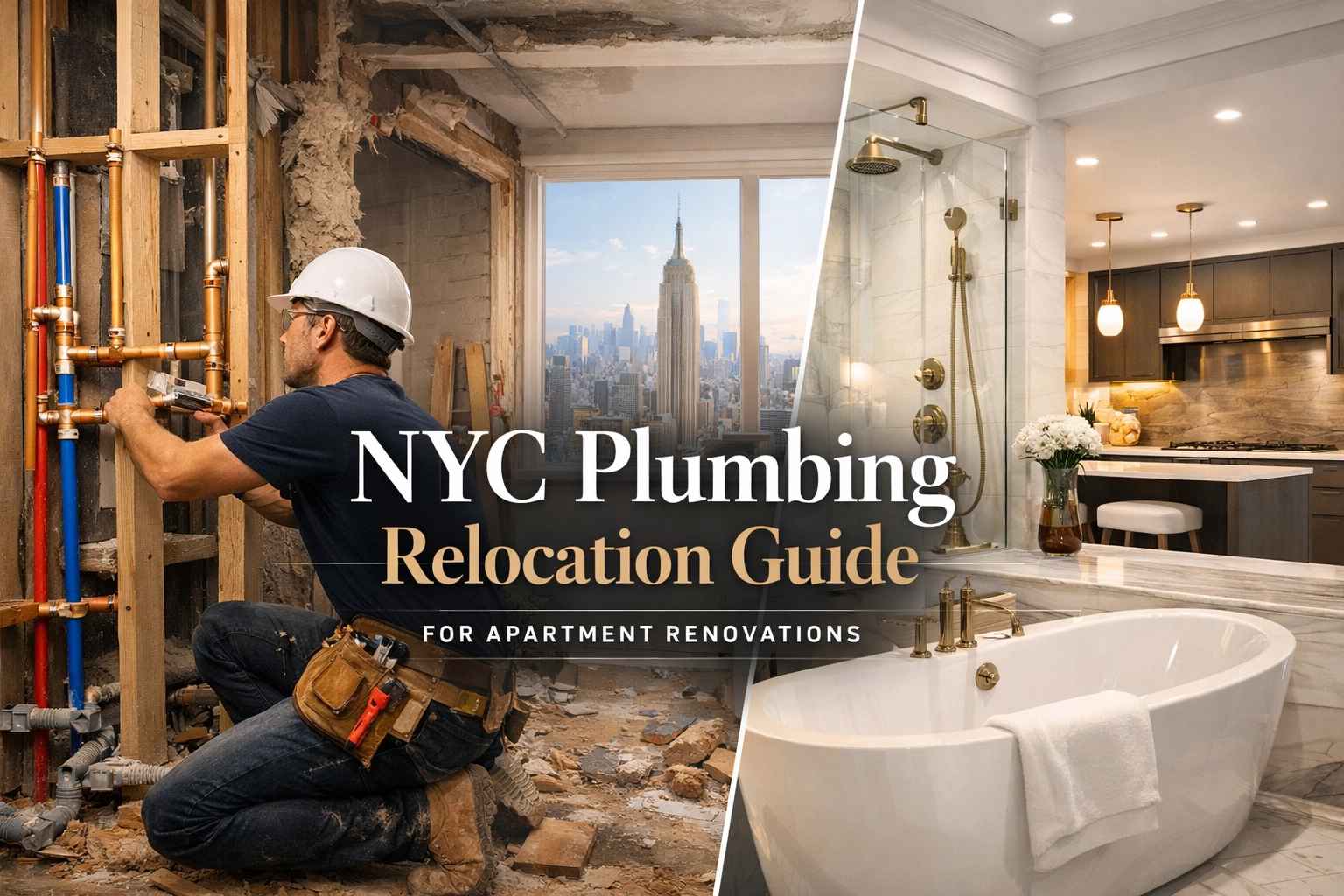
Relocating plumbing in a Manhattan apartment is one of the most significant technical challenges a homeowner can undertake. Unlike a suburban home where pipes are often accessible through a crawlspace or basement, NYC apartments are bound by rigid vertical stacks, thick concrete slabs, and the strict oversight of co-op and condo boards.
At Corniel Construction LLC, we treat plumbing relocation as a surgical operation. It requires precise coordination between the "pit crew" of professionals: the contractor, the architect, the engineer, and the expeditor. This guide explores the complexities of moving wet areas in NYC, from the dreaded "wet-over-dry" rule to the logistics of Department of Buildings (DOB) filings.
Who This Page Is For
This guide is designed for:
- Manhattan Homeowners: Those planning a gut renovation that involves moving a kitchen, adding a bathroom, or relocating a laundry closet.
- Prospective Buyers: Individuals considering an apartment that requires a layout change to reach its full potential.
- Architects and Designers: Professional partners looking for a contractor who understands the technical constraints of NYC building infrastructure.
- Property Managers: Those seeking to understand the standards for plumbing alterations within their buildings.
Understanding the "Wet-over-Dry" Rule
The most common roadblock in NYC plumbing relocation is the "wet-over-dry" rule. In the majority of Manhattan co-ops and condos, building boards prohibit the placement of a "wet" area (a kitchen or bathroom) over a "dry" area (a bedroom or living room) in the apartment below.
The logic is simple: risk management. If a pipe leaks or a tub overflows, the building wants that water to land in another bathroom or kitchen where floors are waterproofed and drains are present, rather than destroying a neighbor’s custom bedroom closets or antique furniture.
Before you fall in love with a new floor plan, you must consult the building’s alteration agreement. Some boards allow minor expansions of wet areas (often up to a certain percentage of the original footprint), while others strictly forbid moving a single pipe beyond the original "wet zone."

The NYC Renovation Workflow: Architects, Engineers, and Expeditors
Relocating plumbing is not a job for a "handyman." It is a regulated structural change that requires a professional team. We partner and collaborate with licensed architects and engineers as needed to ensure every layout change is safe and code-compliant.
The Role of the Architect and Engineer
An architect is required to draw the new layout and ensure it meets NYC Building Code for ventilation and accessibility. If the renovation involves cutting into the concrete slab to move a drain, a common requirement for "curbless" showers, a structural engineer must evaluate the slab to ensure its integrity is not compromised.
The Role of the Expeditor
In Manhattan, an expeditor is a vital player. An expeditor is the professional who manages DOB permit filings (such as Alt-2 filings), tracks approvals, and coordinates documentation between architects/engineers and the contractor. It is important to note that expeditors do not design or build; they move filings and paperwork through the DOB process to ensure your project stays on schedule.
NYC Renovation Permits Explained
Any renovation that moves plumbing fixtures or changes the configuration of gas lines requires a permit from the NYC Department of Buildings. In most cases, plumbing relocation falls under an Alteration Type 2 (Alt-2) filing.
An Alt-2 is required when there are multiple types of work (plumbing, electrical, and structural) that do not change the building's use or occupancy. Unlike a simple "rip and replace" bathroom refresh, which might only require a Limited Alteration Application (LAA), relocation demands a full set of plans filed by a Registered Architect or Professional Engineer.
Failing to secure the proper permits can result in heavy fines, "Stop Work" orders, and significant issues when you eventually try to sell the apartment.
Building Management Coordination and Alteration Agreements
Before work begins, your contractor must satisfy the building management’s requirements. This is often more rigorous than the DOB itself.
- Alteration Agreement: This document outlines the building's rules on plumbing. It may mandate the use of specific materials (like copper vs. PEX) or require that all branch lines be replaced back to the main building stack.
- Insurance and Licensing: Your contractor must provide a COI (Certificate of Insurance) that names the building and the management company as additional insured, often with high umbrella coverage limits.
- Shut-off Valves: Relocating plumbing often requires a "line shut-down." This must be scheduled weeks in advance with the building super to avoid disrupting water service for the entire "line" of apartments.
For a deeper dive into these rules, see our Board Approval Renovation Guide NYC.
How Much Does Bathroom Remodeling Cost NYC?
When you factor in plumbing relocation, the cost of a bathroom renovation increases significantly. You are no longer just paying for tiles and fixtures; you are paying for the technical labor of rerouting drains, venting, and supply lines.
In Manhattan, a bathroom renovation involving relocation typically starts at $35,000 and can exceed $70,000 depending on the complexity of the slab work and the luxury level of the finishes. Relocating a toilet is usually the most expensive move because it requires a 3-inch to 4-inch waste line that must maintain a specific pitch (slope) to drain correctly. If the floor slab is too thin to hide this pipe, you may be forced to build a "platform" or "step up" into the bathroom.

How Much Does Kitchen Remodeling Cost in Manhattan?
Kitchens are slightly more flexible than bathrooms because sink waste lines are smaller (typically 2 inches), but gas line relocation adds a layer of complexity. Moving a gas stove requires a licensed master plumber and often a separate filing with Con Edison, which can lead to lengthy inspections.
A Manhattan kitchen renovation that moves the sink or stove to a new wall generally starts at $50,000 and scales up based on custom cabinetry and appliance choices.
Technical Logistics: Branch Lines and Vertical Stacks
In NYC apartments, you are connected to your neighbors through "vertical stacks." These are the large pipes that carry water and waste up and down the building. Your apartment's "branch lines" connect your fixtures to these stacks.
When relocating plumbing, the biggest constraint is the distance from the stack. Because drains rely on gravity, the further you move a sink from the stack, the higher the pipe must be to maintain the necessary pitch. In many Manhattan buildings, this distance is the "hard limit" on how far a kitchen or bath can move.
Freight Elevator and Work Hour Restrictions
Logistics also play a role in the cost. Plumbing relocation generates heavy debris (old cast iron pipes, concrete from the slab). Manhattan buildings typically only allow work from 9:00 AM to 4:00 PM and require the use of a padded freight elevator that must be reserved in advance. Efficient project management is essential to ensure that the plumber, the super, and the delivery of materials all align during these tight windows.
Planning Your Layout
If you are determined to move your plumbing, consider these strategies to keep the project feasible:
- Back-to-Back Layouts: If you are adding a second bathroom, try to place it adjacent to the existing one to share the same plumbing wall and stack.
- Soffits and Trenches: Be prepared for the aesthetic impact. You may need a dropped ceiling (soffit) in the room below or a raised floor in the room above to hide the new pipes.
- Feasibility Study: Always have your contractor and architect perform a site visit to locate the stacks before finalizing the design.
For more information on navigating these choices, refer to our Manhattan Apartment Renovation Guide.
FAQ
Can I move my toilet to the other side of the bathroom?
It depends on the thickness of your floor slab and the location of the waste stack. Moving a toilet even a few feet can be difficult because the large waste pipe requires a significant slope.
Do I need a permit just to move a sink?
Yes. In NYC, any relocation of a plumbing fixture requires a DOB permit. Replacing a sink in its current location ("rip and replace") usually does not.
What is a "wet-over-dry" rule?
It is a building policy that prevents homeowners from placing kitchens or bathrooms over a neighbor's bedroom or living room to prevent water damage from potential leaks.
How long does a gut renovation take NYC?
A gut renovation involving plumbing relocation typically takes 4 to 7 months, accounting for the time needed for board approvals, DOB permits, and technical inspections.
Is Your Manhattan Renovation Budget Realistic?
Planning a Manhattan renovation? Text or call 917-410-3132 to schedule a renovation feasibility review.