
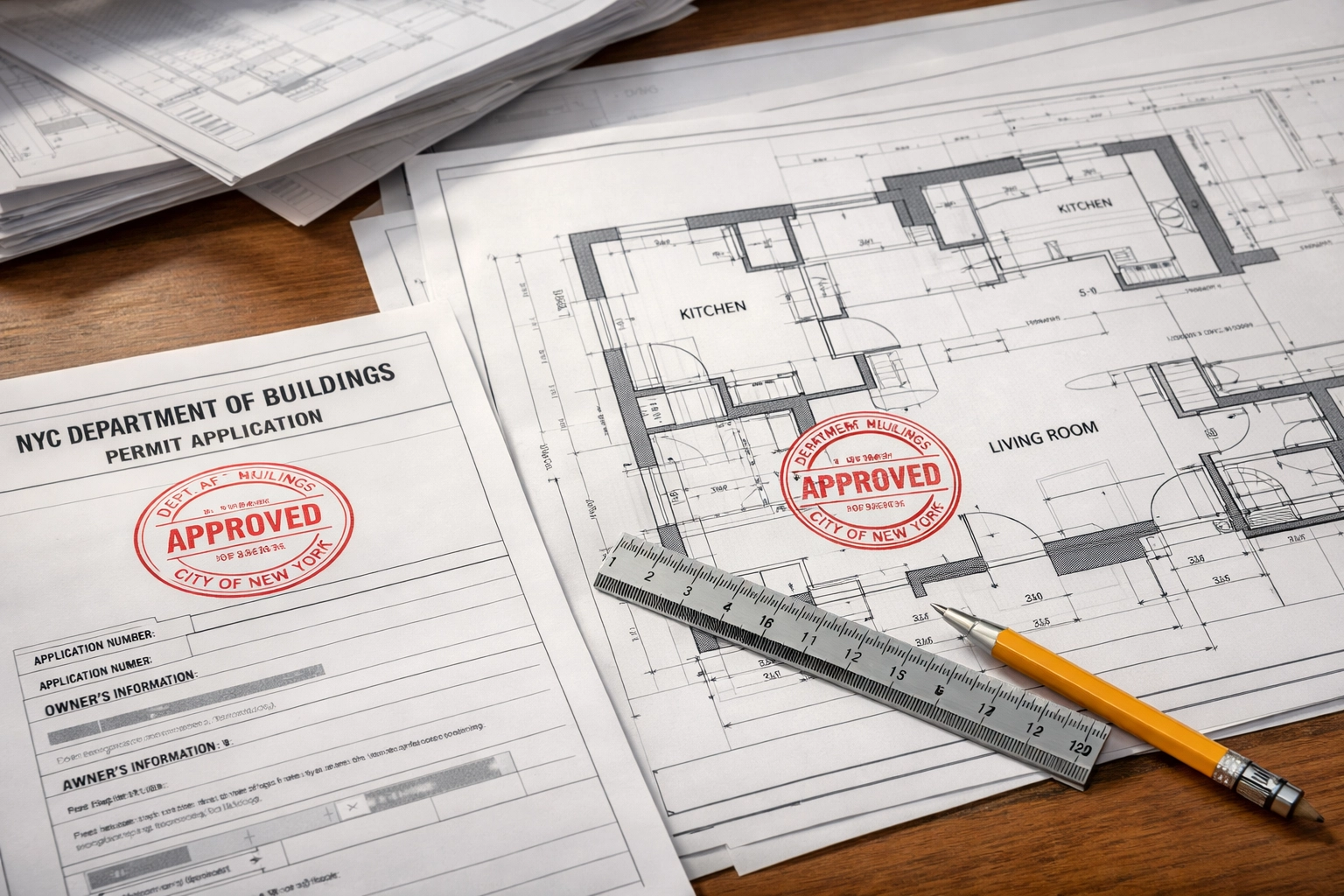
Navigating the bureaucracy of the New York City Department of Buildings (DOB) is often the most daunting part of any Manhattan home improvement project. For many homeowners, the question isn't just about the design or the cost, it’s about legality. In a city where "unpermitted work" can lead to massive fines, stop-work orders, and complications during resale, understanding the NYC renovation permit requirements is non-negotiable.
Whether you are gutting a pre-war co-op on the Upper West Side or modernizing a condo in Tribeca, knowing when you need a permit, and which type, will save you months of delays. This guide breaks down the complexities of the DOB filing process, the differences between Alteration Types, and how to distinguish minor cosmetic work from regulated construction.
Who This Page Is For
This guide is designed for:
- Manhattan Homeowners: Those planning a renovation who need to understand their legal obligations.
- Architects and Designers: Professional partners looking for a contractor who understands the technical nuances of DOB filings.
- Prospective Buyers: Individuals considering a "fixer-upper" who need to factor permit timelines into their purchase decision.
- Property Managers: Who must ensure all work within their building complies with city codes and building bylaws.
For a broader look at the entire renovation lifecycle (budgeting, board approvals, timelines, and construction logistics), start with the central hub: Manhattan Apartment Renovation Guide.
NYC Renovation Permits Explained: The Three Main Categories
In the world of NYC construction, not all renovations are treated the same by the Department of Buildings (DOB). The DOB groups renovation filings into three “Alteration” types: Alt-1, Alt-2, and Alt-3. Manhattan apartment owners usually fall into Alt-2 (and sometimes Alt-3). Alt-1 is less common for apartments, but it matters because it changes the legal status of the space.
Below is the homeowner-friendly way to think about each type, what triggers it, and why it changes your schedule and risk.
Alteration Type 1 (Alt-1): Changes the Certificate of Occupancy (C of O)
Alt-1 is required when the renovation changes the building’s Certificate of Occupancy (C of O)—meaning the DOB is changing the legal description of how the space can be used or how many units exist.
Typical Alt-1 triggers (apartment owners see these less often, but they do happen):
- Changing the number of units (combining or splitting apartments where the C of O must be updated).
- Changing use/occupancy (for example, converting a commercial space to residential).
- Major legalization work where the DOB must issue an updated C of O.
What Alt-1 usually means for you:
- More documentation, more DOB review steps, and more coordination with building management.
- Higher chance of needing multiple disciplines (architect + engineer) and additional sign-offs.
- A longer path to final sign-off because the end goal is an updated C of O.
Manhattan reality check: If you are renovating a typical co-op or condo unit and not changing legal occupancy or unit count, you are usually not in Alt-1 territory.
Alteration Type 2 (Alt-2): The Most Common Manhattan Apartment Renovation Permit
Alt-2 is the standard DOB filing for most “real renovations” in Manhattan apartments. It covers work that may involve multiple trades (carpentry, plumbing, electrical, HVAC), without changing the Certificate of Occupancy.
Alt-2 is commonly required when you:
- Move, remove, or add walls (even if they’re non-load-bearing, because egress, fire rating, and layout can be impacted).
- Reconfigure a kitchen or bathroom (new layout, new fixture locations).
- Move plumbing supply/waste lines (sink, tub, shower, toilet, laundry, dishwasher).
- Move electrical beyond “swap in kind” (new circuits, panel work, relocating major appliances).
- Install or modify HVAC equipment (depending on scope and building systems).
Why Alt-2 matters: Many owners think “it’s inside my unit, so it’s simple.” In Manhattan, the DOB still cares about life safety, code compliance, and trade licensing. Co-op/condo boards also tend to require an Alt-2 package format even when the DOB piece is straightforward.
Alteration Type 3 (Alt-3): Limited Scope, Often Single-Trade Work
Alt-3 is for smaller, more limited projects that generally involve one trade and do not impact the building’s C of O or structural conditions.
Alt-3 examples (when it’s truly limited):
- A targeted plumbing-only scope (handled via a Limited Alteration Application in many cases).
- A targeted mechanical install that doesn’t trigger broader architectural changes.
- Small “single-system” upgrades where the DOB wants documentation and inspections, but not a full multi-trade renovation filing.
Important nuance for Manhattan owners: Even if your project feels “small,” it can still become an Alt-2 if it touches multiple categories (example: moving a sink and adding circuits and changing a wall). Also, many co-op boards treat “minor” renovations as major due to insurance, noise, and neighbor risk—so you still need to align DOB scope with building requirements.
Quick rule of thumb
- Alt-1: Changes the legal occupancy/unit count (C of O changes).
- Alt-2: Typical apartment renovation with layout + plumbing/electrical/HVAC changes (C of O does not change).
- Alt-3: Narrow, limited work—often one trade—no structural/layout implications.

When Do You Actually Need a DOB Permit?
For Manhattan apartment owners, the cleanest way to answer this is: a DOB permit is usually mandatory when you change layout, structure, or the location of plumbing/electrical/mechanical systems. Purely cosmetic work is often exempt—but “cosmetic” is narrower than most people think, and co-op/condo boards can still require a formal alteration agreement, insurance, and approvals.
DOB Permit Mandatory: The Triggers That Usually Put You in Alt-2 (or Alt-1)
If your scope includes any of the items below, plan on a DOB filing (most commonly Alt-2):
-
Structural changes (or anything that could be structural)
- Removing or modifying a load-bearing wall requires engineering and DOB review.
- Even “non-structural” wall moves often require filing because they can affect egress, fire separation, and layout shown on official plans.
-
Plumbing moves (kitchen, bath, laundry)
- Moving a sink, toilet, tub, shower, or washer/dryer typically triggers DOB oversight.
- If you are adding new fixtures or rerouting supply/waste lines, a Licensed Master Plumber is required and the work is either included in the Alt-2 or filed under a Limited Alteration Application (LAA) when appropriate.
-
Gas work
- Any change to gas piping, shutoffs, or appliance connections is tightly regulated and must be performed and filed by the proper licensed trade. This is one of the fastest ways to trigger violations when done informally.
-
Electrical moves and service upgrades
- Adding circuits, relocating outlets as part of a reconfiguration, upgrading a panel, or powering major new loads (ranges, ovens, HVAC equipment) typically requires an electrical permit pulled by a licensed electrician, with required inspections.
-
Mechanical/HVAC installations or modifications
- Installing or relocating HVAC equipment, adding ducts, or changing ventilation pathways can require DOB review and sign-off, depending on the system and building rules.
-
Window/door work that changes openings or impacts the exterior
- Changing size/location of windows or doors can require DOB approval and may also trigger Landmarks Preservation Commission (LPC) review if applicable.
DOB Permit Often Not Required: True Cosmetic Work (“Ordinary Repairs”)
“Ordinary repairs” generally do not require a DOB permit when you are not changing layout, not opening structural assemblies, and not moving plumbing/electrical. Common examples include:
- Painting, wallpaper, skim coating, plaster repairs
- Floor refinishing or installing new flooring when the subfloor/structure isn’t being altered
- Cabinet replacement in the same footprint (no layout changes; no moved plumbing)
- Fixture swaps in kind (same location, same connections): faucet swap, light fixture replacement, etc.
Important Manhattan caveat: Even if the DOB doesn’t require a permit, your co-op/condo board usually still requires approvals, insurance, and work-hour rules. Before you schedule demo, review NYC Co-op Renovation Rules so you don’t get stopped by building management.
Common “Gray Area” Scopes (Where Owners Get Surprised)
These are the scopes that start as “cosmetic” and quickly become permit work:
- “Just moving the sink a few feet” → still a plumbing move, often Alt-2 or LAA.
- “Just taking down one small wall” → may require an engineer letter and DOB filing.
- “Just upgrading appliances” → can trigger electrical load and panel changes.
- “Just adding a washer/dryer” → plumbing, venting, and building restrictions can make it a full filing.
If the goal is to avoid delays, the best approach is early feasibility: confirm whether the scope fits Alt-3/LAA or needs a full Alt-2 before you start pricing and scheduling.
The Role of Design Professionals
At Corniel Construction LLC, we specialize in the technical execution of these projects. We partner and collaborate with licensed architects and engineers as needed.
In Manhattan, you generally cannot file Alt-1 or Alt-2 permit applications as a homeowner. These filings are submitted by a Registered Architect (RA) or Professional Engineer (PE), who prepares the DOB drawing set and associated forms. That DOB set becomes the construction roadmap on-site.
A smart team treats permitting as planning, not paperwork. That means confirming constraints early—wet-over-dry limitations, shaft locations, ventilation pathways, structural conditions, and building-specific rules—before a layout is “final.”

Specialized Permits: Plumbing (LAA) and Electrical
Beyond Alt-1/Alt-2/Alt-3, Manhattan renovations often require trade filings that run in parallel. This is where many owners get tripped up: an Alt-2 does not automatically “cover everything.” Trade permits and inspections still matter.
- LAA (Limited Alteration Application): Often used for specific plumbing scopes that can be filed by a Licensed Master Plumber without a full architectural filing (depending on scope). Examples can include targeted fixture replacements or limited piping modifications.
- Electrical permits: Pulled by a licensed electrician and inspected under electrical requirements. Even when the overall job is Alt-2, electrical is typically tracked as its own permit/inspection path.
If your renovation includes plumbing and electrical moves, expect coordination between the DOB filing set and the trade permits so inspections pass cleanly at close-out.
The Landmark Factor
If your apartment is located in a designated Historic District (common in areas like the Upper West Side, Greenwich Village, SoHo, and Tribeca), the permit process may include an extra review layer. Before the DOB will issue certain permits, you may need a Certificate of Appropriateness or a Permit for Minor Work from the Landmarks Preservation Commission (LPC). This is most relevant for exterior-facing work (windows, doors, façade elements), but it can affect schedule and coordination even when the renovation is primarily interior.
Consequences of Skipping Permits
It is tempting to try and “fly under the radar,” especially when the work is inside your unit. In Manhattan buildings, that strategy usually fails—because neighbors complain, supers notice, and boards require documentation. The risks are real:
- DOB/ECB violations and OATH hearings: If an inspector finds unpermitted work, you can face fines and legal hassle.
- Stop Work Orders: The DOB can shut down the site, leaving your apartment partially demolished while you scramble to legalize the work.
- Insurance problems: If unpermitted plumbing or electrical work causes damage to neighboring units, insurance coverage can become complicated fast.
- Resale and refinance issues: Buyers’ attorneys often check DOB records. Open permits, missing sign-offs, or unrecorded work can delay or kill a deal.
To understand how permits and scope affect your investment, review the Manhattan Renovation Cost Guide.
How We Navigate the Process
At Corniel Construction LLC, permitting is treated as a critical path item, not an afterthought. The goal is simple: keep your project compliant, predictable, and clean at close-out—especially in co-ops and condos where the board package can be just as demanding as the DOB.
We focus on:
- Early feasibility: Confirming whether your scope is trending Alt-3 vs Alt-2, and flagging known building constraints early (wet-over-dry limits, riser locations, shaft access, structural conditions).
- DOB + building coordination: Aligning DOB drawings, trade permits, and building management requirements so you don’t get hit with last-minute change requests.
- Site compliance: Keeping site safety, signage, protection, and logistics organized to reduce the risk of violations.
- Close-out discipline: The job is not “done” until required inspections are passed and filings are closed properly.
Mid-Project CTA: Get a Permit/Scope Reality Check Before You Commit
If you’re planning a Manhattan apartment renovation and you’re not sure whether you need Alt-2 or you can stay in cosmetic/no-permit territory, it’s worth confirming early. A quick review can prevent redesigns, board rejections, and schedule slips.
Book Your Free Estimate for a consultation. For Manhattan owners, Corniel Construction LLC can review your goals, your building constraints, and the likely DOB path before demo is on the calendar.

Is Your Manhattan Renovation Budget Realistic?
Planning a Manhattan renovation? Text or call 917-410-3132 to schedule a renovation feasibility review.
FAQ: NYC Renovation Permits
1) What’s the difference between Alt-1, Alt-2, and Alt-3 in NYC?
Alt-1 changes the building’s Certificate of Occupancy (use/occupancy or unit count). Alt-2 covers most Manhattan apartment renovations that change layout and/or involve plumbing, electrical, or HVAC without changing the C of O. Alt-3 is a narrower filing for limited scopes, often closer to single-trade work with no layout/structural impact.
2) When is a DOB permit mandatory for a Manhattan apartment renovation?
A permit is typically mandatory when you move walls, change egress-related layout, alter structure, relocate plumbing fixtures, modify gas lines, add circuits or upgrade electrical service, or install/relocate HVAC equipment. Most of these land in Alt-2.
3) Do I need a DOB permit to renovate a kitchen if I’m not moving plumbing?
If the kitchen stays in the same footprint and you are swapping cabinets/finishes “in kind,” you may not need a DOB permit. If you move the sink/dishwasher, add new circuits, change ventilation, or modify walls, you are often in Alt-2 territory. Building management may still require approvals either way.
4) Do I need a DOB permit to renovate a bathroom in Manhattan?
If you keep all plumbing fixtures in the same location and it’s truly a replacement-in-kind, a DOB permit may not be required. Once you move a toilet/tub/shower, add a new fixture, or open walls for piping changes, a filing and/or LAA is commonly required—and boards often require documentation regardless.
5) Can my co-op or condo require permits and approvals even if the DOB doesn’t?
Yes. Many Manhattan buildings require an alteration agreement, insurance certificates, licensed/insured contractors, and board/management approval for work that the DOB considers “ordinary repairs.” Always check building rules early. For more, review NYC Co-op Renovation Rules.
6) How long does it take to get an Alt-2 permit in Manhattan?
Timing varies by scope and review pathway, but many Alt-2 filings land in the multi-week to multi-month range when you include plan prep, DOB review, and co-op/condo board approval timelines. If you want a renovation timeline view, start with the Manhattan Apartment Renovation Guide.
For more budget planning and scope clarity, also reference the Manhattan Renovation Cost Guide.
For more information on getting started, Book Your Free Estimate today and let us help you navigate the complexities of NYC construction.