
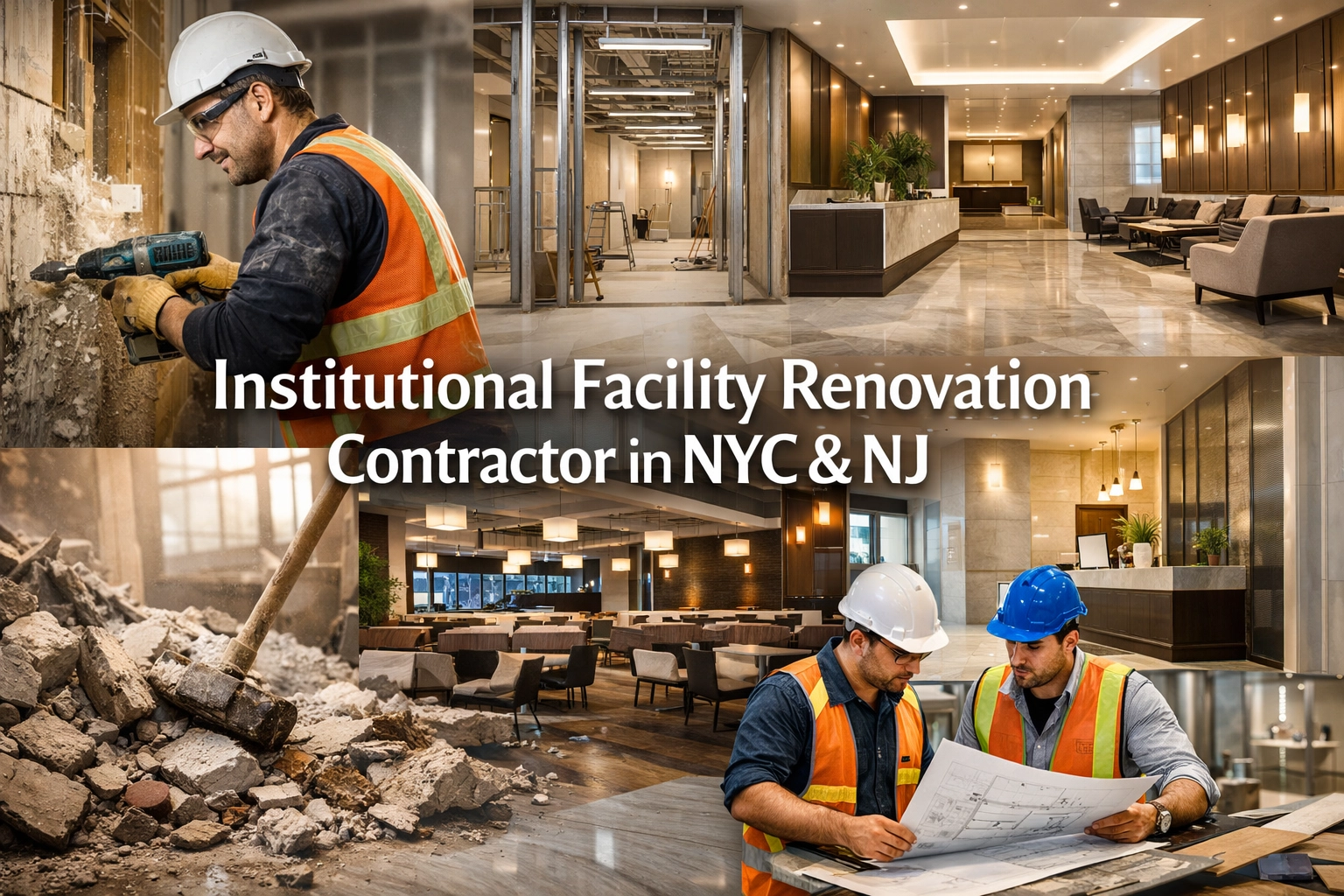
Corniel Construction LLC serves as a premier institutional facility renovation contractor in NYC and NJ, delivering large-scale upgrades for schools, healthcare centers, and religious buildings. We prioritize professional project management and strict compliance with DOB regulations to ensure your facility remains functional, safe, and modernized for its occupants.
Who This Page Is For
This guide is designed for:
- Facility Managers & Administrators: Looking for reliable maintenance and large-scale infrastructure upgrades.
- School Boards & Educational Directors: Planning classroom expansions or safety improvements.
- Healthcare Executives: Requiring specialized medical facility renovations that meet strict health codes.
- Religious Organization Leaders: Seeking to preserve and modernize historic or community-focused structures.
- Architects & Designers: Searching for a technical planning partner to execute complex institutional visions.
The Scope of Institutional Facility Renovations
Institutional renovations differ significantly from standard residential work due to the scale, usage intensity, and regulatory oversight involved. Whether you are managing a private university in Manhattan or a community center in North Bergen, the scope often includes structural reinforcements, high-traffic flooring solutions, and comprehensive mechanical, electrical, and plumbing (MEP) upgrades.
Our approach to Commercial Remodeling focuses on creating durable, efficient spaces. For many institutions, this involves gut renovations of administrative wings, upgrading ADA accessibility to meet current codes, and installing energy-efficient systems that lower long-term operating costs. We partner and collaborate with licensed architects and engineers as needed to ensure every structural change is backed by professional certification.

Alt-text: Large-scale institutional interior renovation featuring upgraded MEP systems and structural framing.
Planning and Professional Project Management
Successful institutional projects are built on a foundation of technical planning. Before a single hammer swings, we conduct a feasibility review to identify building limitations and constraints. In the dense urban environment of Manhattan, understanding the load-bearing capacity of older structures or the limitations of existing electrical grids is vital.
As a technical planning partner, we help stakeholders evaluate the viability of their goals against the reality of the building’s infrastructure. This includes identifying "Wet Over Dry" constraints, a common issue in NYC where placing bathrooms or kitchens over dry occupied spaces is restricted. Professional project management ensures that timelines are synchronized with the institution’s calendar, such as completing school renovations during summer breaks or healthcare upgrades in phased shifts to maintain patient care.

Alt-text: A professional project manager reviewing blueprints for a Manhattan institutional facility upgrade.
Book Your Free Estimate
Ready to discuss your facility’s needs? Book Your Free Estimate with our team to start your project planning today.
The Cost of Institutional Upgrades in NYC & NJ
Estimating the cost of an institutional renovation requires a deep dive into the specific needs of the facility. Unlike residential projects, institutional costs are driven by commercial-grade materials, specialized equipment, and the necessity of high-capacity systems.
Key factors influencing the budget include:
- Specialized MEP Systems: Healthcare facilities may require medical gas lines, while schools need high-speed data infrastructure and advanced HVAC filtration.
- Material Durability: High-traffic environments require industrial-grade finishes that withstand decades of use, impacting initial material costs.
- Logistics: Working in a high-rise Manhattan environment or a restricted-access NJ campus adds logistical costs for debris removal and material delivery.
For organizations operating in Manhattan, budget transparency is critical. We recommend reviewing our Manhattan Renovation Budget Planning Guide to understand how local market trends and labor rates affect large-scale project pricing.
Institutional Renovation Rules and Board Approvals
Navigating the rules of institutional renovation requires more than just construction skill; it requires an understanding of various governing bodies. In addition to the NYC Department of Buildings (DOB), institutions may need to satisfy the Board of Health, the Department of Education, or specific religious diocesan boards.
In Manhattan, even institutional buildings are often subject to NYC Co-op Renovation Rules if they occupy space within a mixed-use or landmarked building. These rules dictate everything from allowable work hours to specific insurance requirements (such as high-limit umbrella policies). We help administrators navigate these complexities, ensuring that all work adheres to both city law and internal facility bylaws.
NYC Renovation Permits Explained
Securing the right permits is the most critical hurdle in any NYC project. For institutional facilities, the process usually involves filing for Alteration Type 1 (Alt-1) for major changes in use or occupancy, or Alteration Type 2 (Alt-2) for multiple-trade work that doesn't change the building's certificate of occupancy.
We emphasize the role of the expeditor in this process. An expeditor is the professional who manages DOB permit filings, tracks approvals, and coordinates documentation between architects/engineers and contractors. It is important to note that expeditors do not design or build; they move filings and paperwork through the DOB process to ensure construction starts on time. For a deeper look at this process, see our guide on NYC Renovation Permit Requirements.

Alt-text: Official NYC Department of Buildings permit posted at a construction site in Manhattan.
Renovation Timelines: Minimizing Operational Downtime
How long does a gut renovation take in NYC? For institutional facilities, the answer depends on the phase-ability of the project. A full-scale renovation of a 20,000-square-foot facility can take 6 to 12 months, but many institutions cannot afford to close.
We utilize a phased construction approach:
- Phase 1: Selective Demolition. Performed during off-hours to minimize noise disruption.
- Phase 2: Infrastructure Upgrades. Focusing on core MEP systems.
- Phase 3: Fit-out. Completing individual wings or floors so they can be re-occupied quickly.
By acting as your Manhattan Renovation Contractor, we coordinate these phases to keep your facility operational. We focus on clear communication and "fast response" to any on-site adjustments needed to accommodate the institution’s daily functions.
Common Challenges in Facility Remodeling
Renovating an active institution presents unique challenges:
- Asbestos and Lead Mitigation: Older NYC and NJ buildings often require specialized environmental remediation before renovations can begin.
- Noise and Dust Control: In environments like hospitals or schools, maintaining air quality and minimizing acoustic disruption is non-negotiable.
- Building Access: Coordinating deliveries in busy neighborhoods like Midtown or Chelsea requires meticulous scheduling to avoid traffic fines and neighbor complaints.
Our team is experienced in handling these constraints, providing early feasibility evaluations to catch potential roadblocks before they become costly delays.

Alt-text: Construction crew implementing dust control measures during a facility renovation in North Bergen, NJ.
Is Your Manhattan Renovation Budget Realistic?
Institutional projects are complex, and the NYC market is unique. Ensuring your budget accounts for permits, expeditors, and high-end commercial finishes is the first step toward a successful renovation.
Planning a Manhattan renovation? Call or text 917-410-3132 to discuss your project.
Book Your Free Estimate
Take the next step in your facility's evolution. Book Your Free Estimate with Corniel Construction LLC.
FAQ: Institutional Facility Renovation
What is the difference between an Alt-1 and Alt-2 permit for a facility?
An Alt-1 permit is required when the renovation changes the building's Certificate of Occupancy, such as changing a commercial space into a school. An Alt-2 is used for renovations that involve multiple trades (plumbing, electrical) but do not change the building's use or occupancy level.
Can you renovate a facility while it remains open?
Yes, this is common in institutional work. We use phased construction and off-hours scheduling to ensure that critical services remain available while the renovation progresses.
How do you handle ADA compliance in older NYC buildings?
We partner and collaborate with licensed architects and engineers as needed to design ramps, widened doorways, and compliant restrooms that meet current Americans with Disabilities Act (ADA) standards while respecting the building's structural integrity.
Do you provide facility maintenance after the renovation is complete?
Yes, we offer ongoing maintenance and repair services to ensure that the new upgrades continue to perform efficiently in high-traffic institutional environments.
Which areas do you serve for institutional renovations?
Our primary focus is Manhattan, including the Upper West Side, Midtown, and the Financial District. We also serve North Bergen and other NJ areas near the George Washington Bridge, as well as Brooklyn and Queens.
Durability and Occupied-Facility Coordination
Review anticipated traffic, cleaning practices, moisture exposure, accessibility needs and maintenance access when selecting finishes for institutional spaces. Compare materials by their suitability for the actual facility, including repairability and replacement access, rather than by appearance alone. Define the work area and protection measures before construction starts.
For an occupied facility, coordinate phased access, separation of work areas, delivery and debris routes, planned service interruptions and communication with the operator. Confirm which spaces must remain available and which may close during the work. The sequence depends on the approved scope and the facility’s operational constraints; keeping every area open or guaranteeing a particular completion window cannot be assumed.