
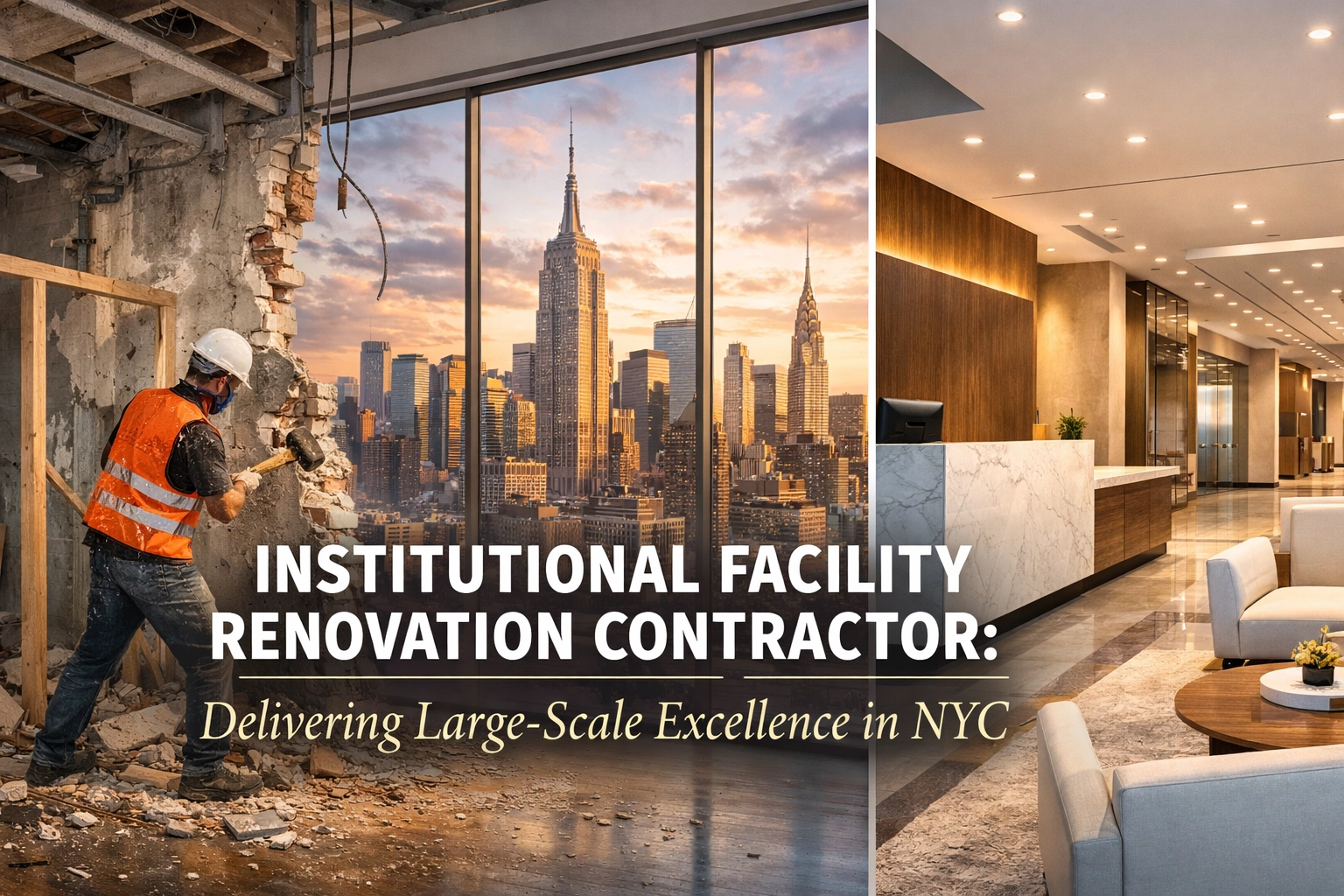
NYC institutional renovations require a specialized approach to scale, durability, and compliance. Corniel Construction LLC provides expert management for large-scale facility upgrades, ensuring high-traffic environments like schools and medical centers remain functional while undergoing transformative improvements that meet strict New York City building codes and safety regulations.
Who This Page Is For
This guide is designed for:
- Facilities Managers overseeing large-scale institutional assets.
- Institutional Boards and non-profit directors planning long-term capital improvements.
- Architects and Designers seeking a technical construction partner for complex NYC builds.
- Healthcare Administrators requiring specialized medical suite renovations.
- Educational Leaders looking to modernize campus facilities without disrupting student life.
The Scope of Institutional Renovation in NYC
Institutional renovation is fundamentally different from standard residential work. While we are a premier Manhattan renovation contractor, our institutional division focuses on the unique demands of Tier 3 clusters: large-scale buildings, community centers, and specialized facilities.
The scope often includes full-scale structural upgrades, ADA compliance overhauls, and the integration of high-efficiency MEP (Mechanical, Electrical, and Plumbing) systems. A prime example of our capability in this sector is the Esperanza project, where Corniel Construction demonstrated its institutional expertise by managing complex requirements while prioritizing long-term durability and facility management needs.
Whether it is a university expansion or a community healthcare clinic, we focus on the "Manhattan Authority Boss Strategy": meaning we take full ownership of the technical planning and execution to ensure the facility serves the public for decades to come.

Planning and Feasibility: The Technical Partner Approach
At Corniel Construction LLC, we position ourselves as a technical planning partner. For any large-scale NYC apartment renovation or institutional facility, the process must begin with a deep feasibility review. We identify building limitations, such as aging vertical stacks or structural load capacities, long before the first hammer swings.
We partner and collaborate with licensed architects and engineers as needed to ensure that every design choice is backed by structural integrity. This early-stage collaboration allows us to provide a realistic outlook on what can be achieved within the constraints of NYC’s dense urban environment.
Schedule Your Consultation
NYC Renovation Permits Explained
Navigating the Department of Buildings (DOB) is often the most significant hurdle in institutional work. Large-scale renovations typically require Alt-1 or Alt-2 filings.
To manage this, we work closely with expeditors. An expeditor is the professional who manages DOB permit filings, tracks approvals, and coordinates documentation between architects, engineers, and contractors. It is important to note that expeditors do not design or build; they are the specialists who move paperwork through the DOB process to keep the project on schedule.
Understanding NYC renovation permit requirements is vital for institutional facilities, especially those involving "Wet Over Dry" restrictions or Landmarked structures. Our team ensures that all filings are accurate to avoid costly stop-work orders.
Co-op Renovation Rules Manhattan and Institutional Compliance
While "co-op renovation rules Manhattan" usually applies to residential apartments, the principles of building management approval apply to institutional facilities located within mixed-use or multi-tenant buildings.
Managing a renovation in a shared Manhattan environment requires strict adherence to:
- Work Hours: Minimizing disruption to neighboring tenants or students.
- Insurance Requirements: Meeting the high-liability thresholds required by NYC institutions.
- Protection Protocols: Ensuring common areas and shared elevators are protected throughout the demolition and construction phases.

How Long Does a Gut Renovation Take NYC (Institutional Scale)?
Timeline management is critical when a facility must remain operational. A standard institutional gut renovation can take anywhere from 6 to 18 months, depending on the square footage and complexity of the mechanical systems.
Key factors affecting the timeline include:
- Approval Phase: DOB and board approvals can take 3 to 5 months.
- Procurement: High-end institutional materials or specialized medical equipment often have long lead times.
- Phased Construction: To keep facilities open, we often work in phases, which extends the total timeline but allows for continuous operation.
For more details on how we manage these phases, see our Manhattan apartment renovation timeline guide.
Managing Costs: Commercial Remodeling in NYC
Budgeting for an institutional facility requires a focus on "Life Cycle Costing" rather than just the initial price tag. Because these spaces face extreme wear and tear, we prioritize long-term durability over cheaper, residential-grade finishes.
- High-Traffic Flooring: Industrial-grade solutions that withstand thousands of footsteps daily.
- Advanced HVAC: Systems designed for energy efficiency and easy facility management maintenance.
- Sustainable Materials: Aligning with modern NYC energy mandates like Local Law 97.
When planning your budget, it is helpful to look at benchmarks like the NYC kitchen renovation cost guide, though institutional costs will scale based on industrial requirements.

Case Study: The Esperanza Project
- Neighborhood: Upper Manhattan / Washington Heights
- Building Type: Institutional / Community Facility
- Scope: Full-scale renovation focusing on facility durability and modernized administrative spaces.
- Constraints/Approvals: Required strict DOB compliance and coordination with local community stakeholders.
- Final Outcome: A robust, modern facility delivered on time, providing long-term value to the organization and the neighborhood.
Our work on the Esperanza project highlights our commitment to the Washington Heights and Harlem communities, where we have served as a trusted general contractor for through substantial Manhattan renovation experience.
Challenges and Durability in High-Traffic Environments
Institutional facilities are unique because they cannot afford downtime. A leak or a power failure in a medical suite or a school is a major crisis. This is why we focus on "Building Management Renovation."
We don't just "beautify" a space; we harden it. We evaluate the verticality of the building, the age of the risers, and the capacity of the electrical panels. By identifying these building-wide constraints early, we prevent the "surprises" that usually derail large-scale NYC projects.

FAQ: Institutional Renovation in NYC
What is the difference between an institutional contractor and a residential contractor?
Institutional contractors handle larger scales, higher insurance requirements, and more complex regulatory compliance (like ADA and NYC Health Department codes), whereas residential contractors focus on individual unit aesthetics and co-op board rules.
Does Corniel Construction LLC handle DOB filings?
We manage the process by coordinating with licensed architects and professional expeditors who handle the actual filings (Alt-1, Alt-2, Alt-3) with the NYC Department of Buildings.
How do you handle renovations while a facility is still in use?
We utilize phased construction and off-hours work schedules to minimize noise and dust, ensuring that the primary functions of the institution can continue safely.
Why is durability so important in institutional work?
Institutional spaces face 10x the wear of a residential home. Using commercial-grade materials and industrial construction methods ensures the renovation lasts 20+ years instead of showing wear in 5.
Is Your Manhattan Renovation Budget Realistic?
Large-scale institutional work requires a realistic approach to both time and capital. In the NYC market, cutting corners on permits or materials invariably leads to higher costs down the road through fines or repairs.
Planning a Manhattan renovation? Call or text 347-567-1018 to discuss your project.